Up to Date
| Points | Difficulty | Category |
|---|---|---|
| 100 | Beginner | Misc |
Description
Our newly hired developer at our company seems to be big on vibe coding, and asked Claude Sonnet to generate some Zen-C code in a moment of hurried inspiration. They attempted to send this code over our system, but it seems like something went wrong with the transmission, resulting in custom TCP payloads! The code got split up into multiple chunks, and some network noise has been mixed in with the transmission. Luckily, they’ve done some preliminary analysis of the packets and determined how the valid and noise packets were transmitted and given you their annotations. Unfortunately though, we aren’t exactly Up To Date with what the new generation is up to today, so we leave the decoding task to you. Filter the noise, reverse the custom protocol, and analyze the Zen-C source code.
Objective
The objective was to recover the hidden flag from a set of provided files: chall.py and output.txt
Flag Format
The flag format will either be: SVBRG{This_is_a_Flag} or SVIBGR{This_is_a_Flag}
Tools Used
- Terminal was used as a primary tool to execute Python
python3 solve.py - File Management to navigate all of the folders on the Desktop and organizing the files.
Methodology
The first step included analyzing the file chall.py to understand how the secret was hidden. To open the python file, I right clicked and opened the file with a text editor.
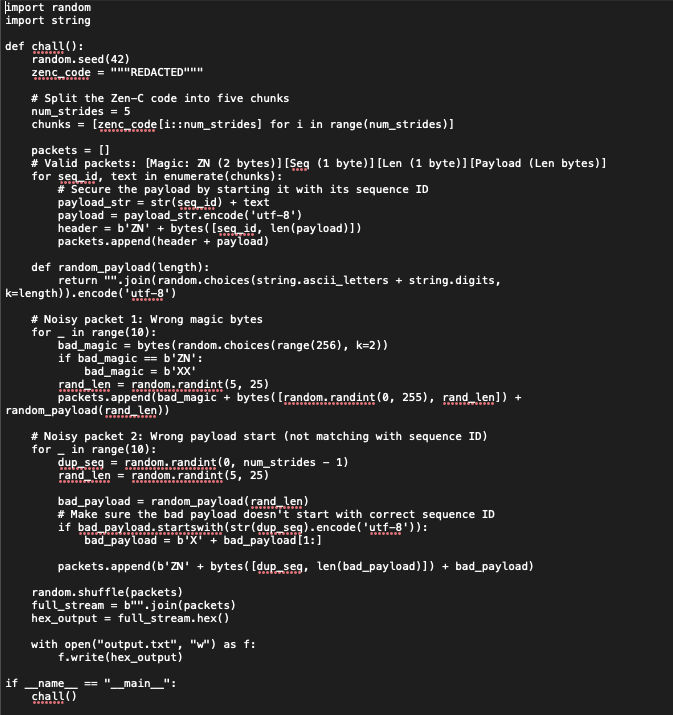
I discovered the chall.py file included secret text split into five chunks and each chunk was wrapped was in a packet starting with a Magic Header (ZN), followed by a Sequence (Seq) number, and the Length (Len) of the data. It seems like the script added fake noise to the file to confuse the search tools.
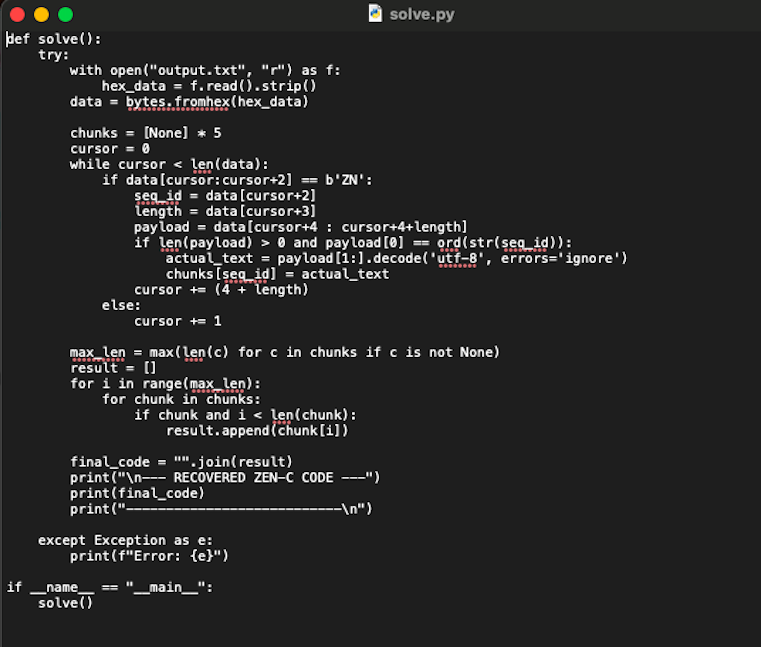
Since the challenge also included a file called solve.py, I took a look at it to better understand how the packets were being reconstructed.
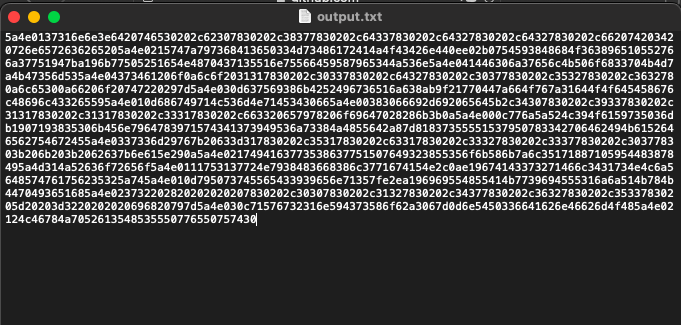
I used the Python script, solve.py to recover the flag, which scanned the output.txt file for the ZN magic bytes.
It also checked if the packet started with the correct Sequence ID and placed the chunks back together in the proper order. A piece of code was recovered in a fictional language called Zen-C.
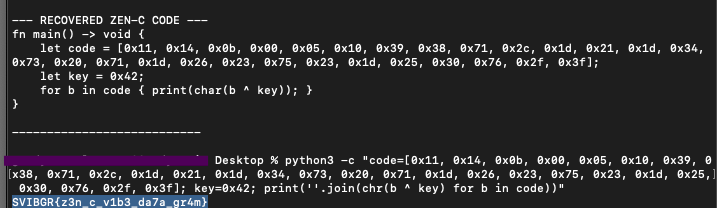
The recovered Zen-C code revealed an XOR Cipher that used a single key (0x42)and the flag was revealed!
Flag
SVIBGR{z3n_c_v1b3_da7a_gr4m}
Key Lessons
- Careful with running the challenge script: Often,
chall.pyis just a map to show how the puzzle was made. Running it can overwrite the evidence (like what happened to theoutput.txt). - Magic Bytes are Clues: Whenever you see a repeating pattern like
ZNin a hex file, it’s usually a “Header” that tells you where a piece of important data starts. - XOR Spotting: If you see a list of hex numbers and a single key, such as
0x42, it is often that XOR was used to hide the data.
MITRE ATT&CK
Reflections | Suggestions | What was the Attacker Doing?
This challenge required reconstructing fragmented data and decoding an XOR protected payload to recover the hidden information.
| Field | Details |
|---|---|
| ID | T1140 |
| Tactic | Defense Evasion |
| Mitigation | Review scripts and encoded files for hidden or obfuscated content. Analyze suspicious files inn controlled environment before execution. |
| Detection Strategy | Monitor for tools, scripts, or processes that decode, deobfuscate, or reconstruct encoded information from files. |
Source: https://attack.mitre.org