D7. Endpoints and Exfiltration
Points: 100
Level: Not as Difficult
Category: Endpoint Forensics
Description
In D5, we identified the backup server that is the source of the transfer, and the IP address that the threat actor is possibly sending data to. Now, what software on the backup server is responsible for the exfiltration? The data files you’ve been given contain the outputs of shell commands run directly on the endpoint. You’ll be examining the outputs of the commands “lsof”, “ps”, and “history.”
Objective
Your task is to identify the OS process, user, and software that is performing the exfiltration, and where the software came from.
Flag Format
To build the flag, you’ll need:
- The username on the backup server that is running the exfil process (USER).
- Name of the executable file that actually created the exfil process (FILE).
- Process ID (PID) of the process performing the exfiltration. The format of the flag will be USER_FILE_PID.
Tools Used
Data file (endpoint-outpoint.zip), Text Editor
Methodology
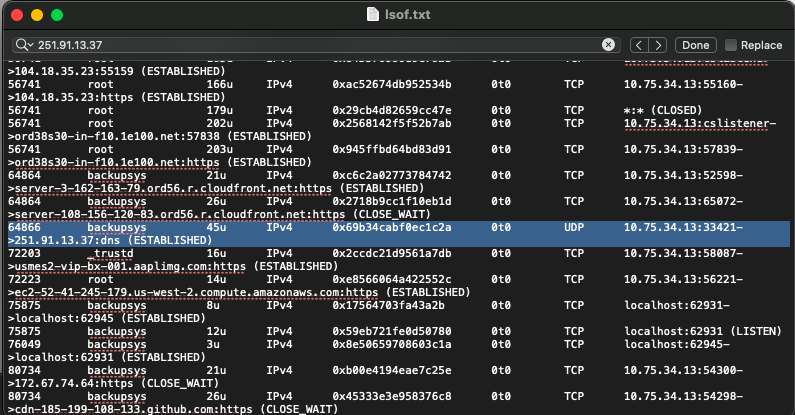
There were three text files to review: bash-history.txt, lsof.txt, and ps.txt. The findings from challenge D5 revealed the IP source (10.75.34.13); IP destination (251.91.13.37); and Protocol used (DNS) which will come in handy to complete this challenge. I opened the lsof.txt file first, clicked “edit” and “find” and typed in the search box “251.91.13.37” to see what information appeared. Fortunately, there was only one hit, and this gave us the PID (64866) and the User (backupsys) which was part of the flag answer.
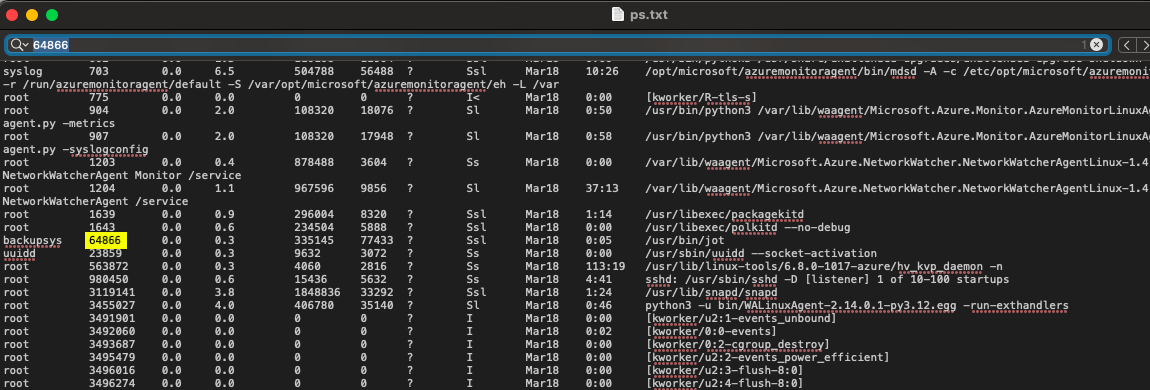
To get the executable file name or the third part of the flag, the file ps.txt was opened and a search with 64866 from the lsof.txt revealed one matching entry and the command being executed is: /usr/bin/jot.
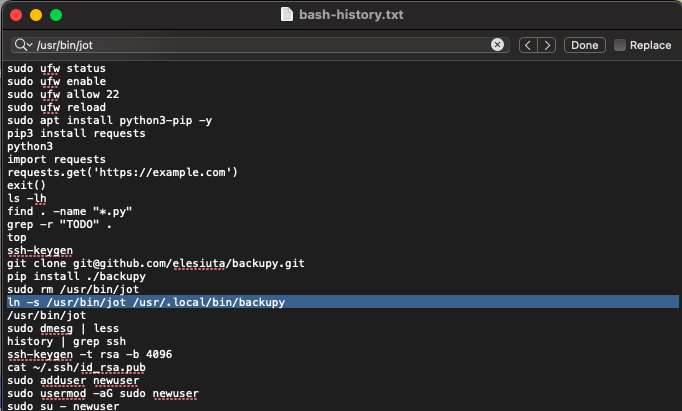
I then opened the final file, bash-history.txt, conducted a search for “/usr/bin/jot,” which revealed the following:
sudo rm /usr/bin/jot
ln -s /usr/bin/jot /usr/.local/bin/backupy
/usr/bin/jot
This tells me, the sudo line deletes the authentic “/usr/bin/jot” and ln -s creates a link from “backupy” to /usr/bin/jot, which means that’s the malicious file and the answer to the final part of the flag.
Flag
backupsys_backupy_64866
MITRE ATT&CK
(Suggested)
- Masquerading (T1036): The attacker replaced the legitimate /usr/bin/jot binary with a malicious program, making it appear as a normal system utility.
- Command and Scripting Interpreter (T1059): Evidence in bash-history.txt showed the attacker leveraging shell commands to manipulate files and establish execution.
- Indicator Removal or Modification (T1070): The
sudo rm /usr/bin/jotstep was used to remove the authentic binary, erasing traces of normal operation.